
The Scapula is the Butt of the Neck
Originally published in 2017. Updated in 2026 with additional information about cervical centralization and Mechanical Diagnosis & Therapy.
A surprising number of people, including physicians, are unaware of the way the spine can refer pain to other parts of the body. It is much more common to see an understanding of lumbar spine referral patterns, or to hear people refer to pain traveling into the leg as “sciatica,” while cervical spine referral patterns can be less obvious.
Many people understand that their “pain in the butt” may actually be coming from their low back. Pain that originates from the lumbar spine can be felt in the buttock and, in some cases, farther down the leg. A very similar process can occur in the cervical spine, producing that hard-to-localize pain around the scapula, or shoulder blade, that many of us feel, especially after sitting at a computer or holding one position for a long time.
Take a look at the illustrations below.
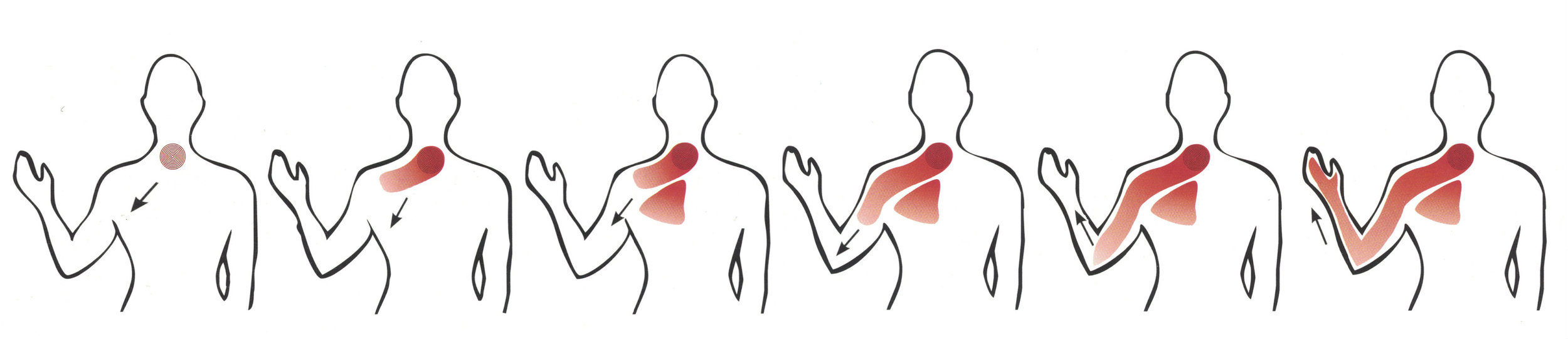
Cervical spine referred pain patterns showing symptoms spreading from the neck and shoulder blade into the shoulder and arm.

Lumbar spine referred pain patterns showing symptoms spreading from the low back into the buttock and down the leg.
Notice that in both instances, symptoms can begin centrally, in the low back or neck, and then spread farther away from the spine. In the low back, they may move into the butt and down the leg. In the neck, they may move into the shoulder blade, shoulder, and arm. That’s why I like to say that the scapula is the butt of the neck. In McKenzie Mechanical Diagnosis & Therapy (MDT), movement of symptoms farther away from the spine is called peripheralization.
But the pattern can also happen in reverse.
What is cervical centralization?
Centralization occurs when symptoms that have spread away from the spine begin to retreat back toward it in response to particular movements or positions. With a neck problem, for example, pain or tingling in the hand or arm might retreat toward the shoulder, then the shoulder blade, and eventually become more localized around the neck.
This is important because simply asking whether pain is “better” or “worse” can miss useful information. Imagine that your neck pain temporarily feels a little stronger, but the pain that had been traveling down your arm has disappeared and is now confined to the neck. In MDT, that change in location can be more meaningful than the intensity of the pain alone.
The opposite can also happen. If repeated movement causes symptoms that were around the neck or shoulder blade to spread progressively farther into the arm or hand, that is peripheralization. That response may be a sign that the movement or direction being tested is not the right one for that particular problem.
This process of testing movement and watching how symptoms respond is one of the central ideas behind the McKenzie Method, more formally known as Mechanical Diagnosis & Therapy (MDT). I’m certified in MDT and have used this approach to evaluate and treat neck and back pain for more than a decade.
That pain in the neck can be a real pain in the butt... am I right, or am I right?
Want to test what your symptoms respond to?
The NeuroActive Pain Guides walk you through a response-based process for testing movements, tracking meaningful symptom changes, and knowing when self-care is not appropriate.
